
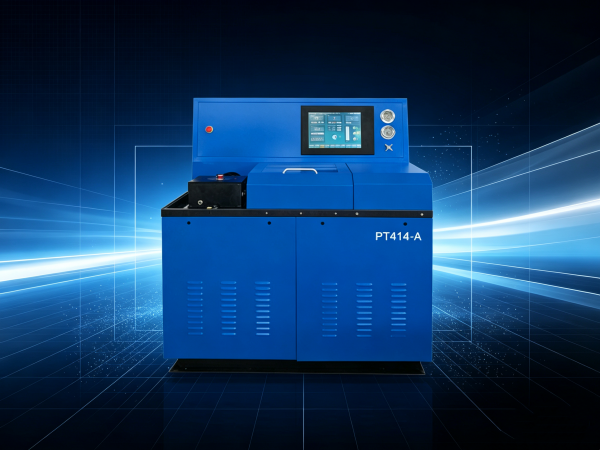
The Beacon PT411 is a specialized PT injector test bench designed for the diesel engine maintenance and component inspection markets, providing standardized testing solutions for fuel quantity measurement of PT series injectors. Addressing industry concerns regarding equipment compatibility, accuracy, operation, and maintenance, it features 10 key Q&A sections:
1. Q: What types of fuel injectors are primarily suitable for testing with the PT411 injector test bench?
A: This device is a specialized COMAX PT fuel testing system capable of measuring injection volumes for various PT injector models, including PT cylinder-type and PT(K)-type units, making it ideal for maintenance and calibration of mainstream PT series injectors.
2. Q: What are the core advantages of the PT411 testing bench in terms of detection accuracy?
A: The device features digital oil level display with a single-test accuracy of ±1 mL and a measurement accuracy of ±0.1 mL over 1,000 cycles; it is equipped with a high-precision sensing and measurement system that ensures delayed data retention and automatic zeroing, enabling stable data acquisition after just 1–2 tests, eliminating leakage in measurements, and preventing valve body leaks from affecting test results.
3. Q: What is the fuel injection range detectable by the PT411 test bench?
A: It supports fuel injection measurement across the entire range of 90–500 ml per 1000 strokes, meeting the testing requirements for the majority of PT-type injectors available on the market.
4. Q: What control system does the PT411 use, and how effective is its temperature regulation?
A: The entire unit employs a PLC-based core electrical control system for precise operational control; the fuel tank features a fully automatic temperature control system that maintains test oil at a stable temperature of 32–38°C. Pre-set temperature parameters are provided upon factory delivery, eliminating the need for additional calibration by users.
5. Q: What are the key hardware specifications of the PT411 test bench?
A: Dimensions: 980 × 720 × 1510 mm; Total weight: 400 kg; Main motor: 1.1 kW; Oil pump motor: 0.55 kW; Oil pump rated working pressure: 2.5 MPa; Power supply: 380 V three-phase AC; Maximum piston stroke: 70 mm; Clamping force: 1.9 kN; Oil tank capacity: 25 L.
6. Q: Are there strict specification requirements for the dedicated test oil used with PT411?
A: There are stringent standards: kinematic viscosity at 28°C ranging from 2.55 to 2.85 Cst; specific gravity at 15.6°C between 0.819 and 0.829; flash point ≥75°C; cloud point ≤−10°C; corrosion resistance duration ≥100 hours; as well as specified requirements for sulfur content, distillation temperature, and foam characteristics.
7. Q: What conditions must be met on-site for installing the PT411 test bench?
A: ① The site must be level and dust-free, with sufficient operating space reserved; ② Stable 380 V/50 Hz three-phase power supply; ③ Cooling water supply pressure ≥ 2.5 kg/cm² and inlet temperature ≤ 27°C; ④ Environmental temperature maintained between 16°C and 32°C.
8. Q: What is the function of the built-in simulated backpressure feature in the device?
A: It is a high-precision backpressure simulation module that replicates the compression and fuel injection conditions within the engine cylinder, ensuring that the fuel injection testing results on the test bench match the actual operating conditions of the engine, thereby significantly enhancing the authenticity of the test data.
9. Q: What are the key safety precautions for daily use of the PT411?
A: The equipment must be reliably grounded; after the main motor is shut down, the injector clamping duration shall not exceed 1 minute; maintain a safe distance from moving parts such as cams during operation; inspect the oil supply nozzle's O-ring seal before each test to prevent oil leakage; electrical faults must be diagnosed and repaired by qualified personnel; unauthorized disassembly or replacement of components is strictly prohibited.
10. Q: How should common equipment faults such as a non-functional oil pump or failure to measure flow be initially diagnosed?
A: For a non-functional oil pump, first check the oil pump control button and motor wiring; for measurement failure, prioritize inspection of the flow sensor, hydraulic valve, and control program; for abnormal oil pressure, adjust the pressure regulating valve; for a non-starting main motor, the issue often stems from the cam not returning to its rising position; if any fault cannot be resolved independently, contact professional technical personnel; unauthorized disassembly is strictly prohibited.


 Language
  EN
EN RU
RU ES
ES DE
DE EL
EL IT
IT JA
JA KO
KO PT
PT ID
ID SR
SR UK
UK VI
VI TH
TH TR
TR MS
MS BE
BE AR
AR